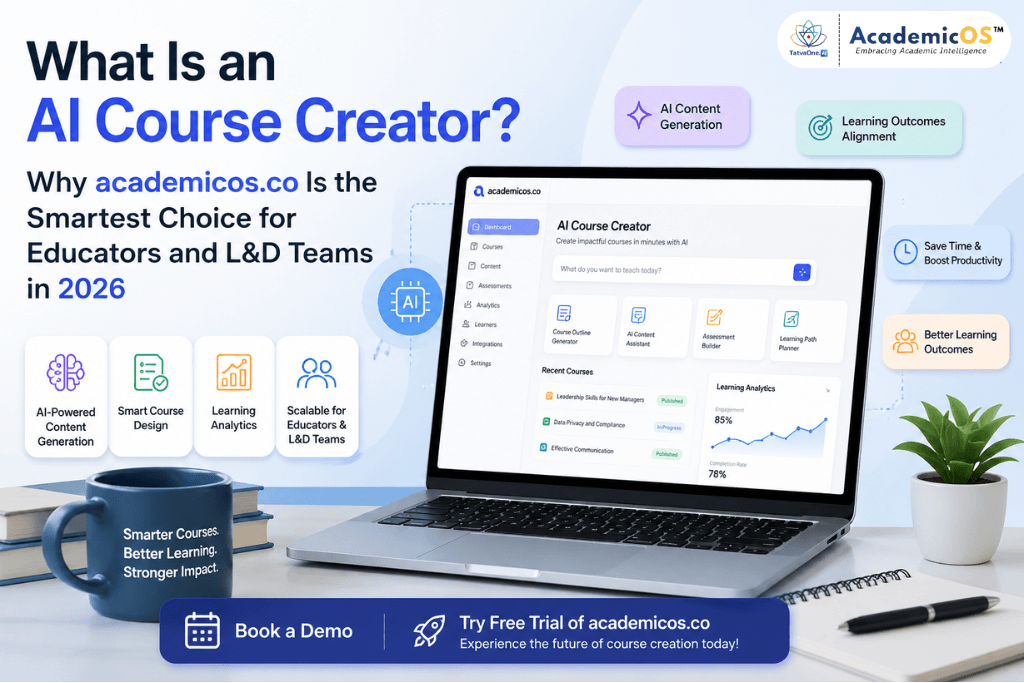
See how AcademicOS leverages hallucination-free AI assisted course creation to build trust, compliance, and high-quality learning ecosystems.
The rise of structured learning ecosystems is redefining how education is delivered and experienced. Ready to transform your academic ecosystem? Start your free trial now: https://academicos.co/ We are moving beyond isolated tools and fragmented content toward integrated platforms that connect curriculum design, learning delivery, assessment, and outcomes into one cohesive system. The real insight? Learning is no longer just about content consumption—it’s about creating a continuous, data-driven loop of improvement. Institutions that embrace structured ecosystems will:
- Deliver consistent and measurable learning outcomes
- Align education with industry needs
- Scale quality education without increasing complexity
The future belongs to systems, not silos.

The Imperative of Trusted AI in 2026 Course Creation
In 2026, Artificial Intelligence (AI) has become an indispensable tool in education, with a significant majority of students and educators actively integrating it into their daily routines. Approximately 86% of students globally use AI for their studies, a figure that jumped from 66% in 2024 to 92% in 2025, demonstrating its rapid adoption. Similarly, 60% of educators utilize AI in their regular teaching practices. This widespread integration highlights AI’s potential to enhance learning outcomes, with AI tools reportedly boosting passing rates by 15% and increasing course completion by 70%.
However, as AI’s role in creating academic content expands, the demand for trusted AI for academic content becomes paramount. The global AI education market is projected to reach $112.03 billion by 2034, underscoring the financial and educational stakes involved. Trust is crucial because AI systems, particularly Large Language Models (LLMs), are not infallible. They can produce plausible-sounding but factually incorrect information, a phenomenon known as “hallucination.” This challenge necessitates a focus on AcademicOS hallucination free course creation to maintain academic integrity and ensure effective learning.
Why Hallucination-Free AI is Critical for Academic Content
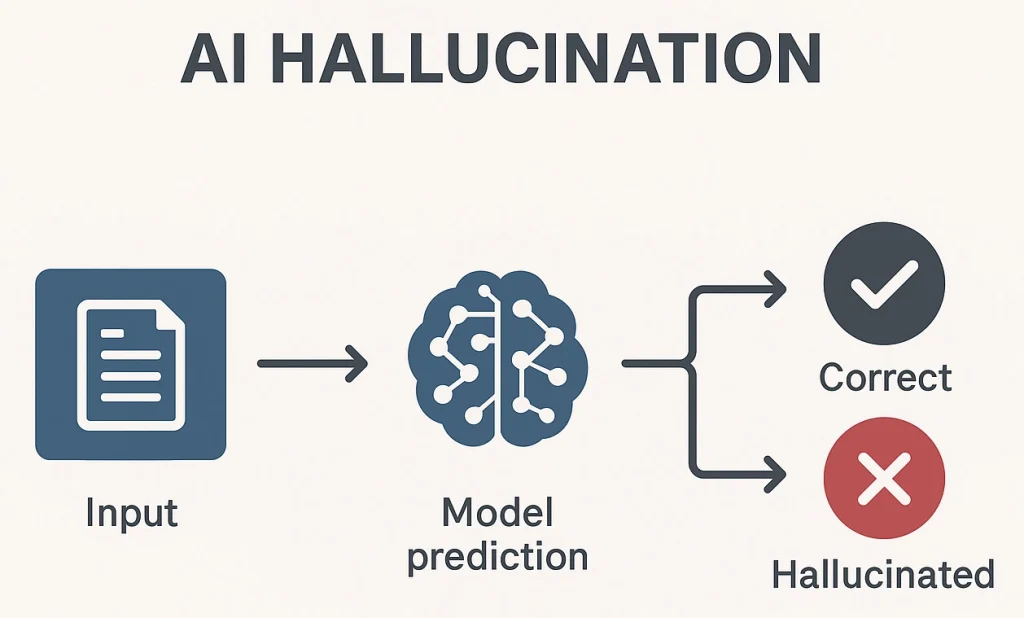
AI hallucinations occur when an AI model generates content that appears coherent and confident but is factually inaccurate, irrelevant, or unsupported by its source data. This can range from subtle inconsistencies to significant factual errors and misinformation. The implications for academic content are profound:
- Damage to Credibility: If AI-generated course materials contain hallucinations, the credibility of the institution, instructors, and the content itself is severely undermined.
- Misleading Learners: Students relying on flawed information may develop misconceptions, make costly mistakes, or struggle to grasp accurate concepts. This can lead to a “hallucination of learning,” where students feel they have learned but have actually absorbed incorrect information.
- Compliance and Legal Risks: In fields requiring high precision, such as healthcare, law, or compliance training, AI hallucinations can lead to serious legal and financial repercussions if incorrect procedures or outdated regulations are disseminated.
- Time and Resource Waste: Educators may spend excessive time fact-checking and editing AI-generated content, negating the efficiency benefits AI promises. Retraining AI tools due to extensive errors can also be a lengthy and costly process.
The issue is compounded by the fact that LLMs often present incorrect information with the same level of confidence as accurate data, making it difficult for non-experts to distinguish truth from fabrication. As students increasingly use AI, with 92% of higher education students using generative AI, addressing hallucinations is vital to prevent an overreliance on potentially flawed tools and to foster critical thinking.
Strategies for Achieving Trusted, Hallucination-Free AI Course Creation
Achieving AcademicOS hallucination free course creation requires a multi-faceted approach, combining advanced AI techniques with robust human oversight.
Leveraging Advanced AI Techniques
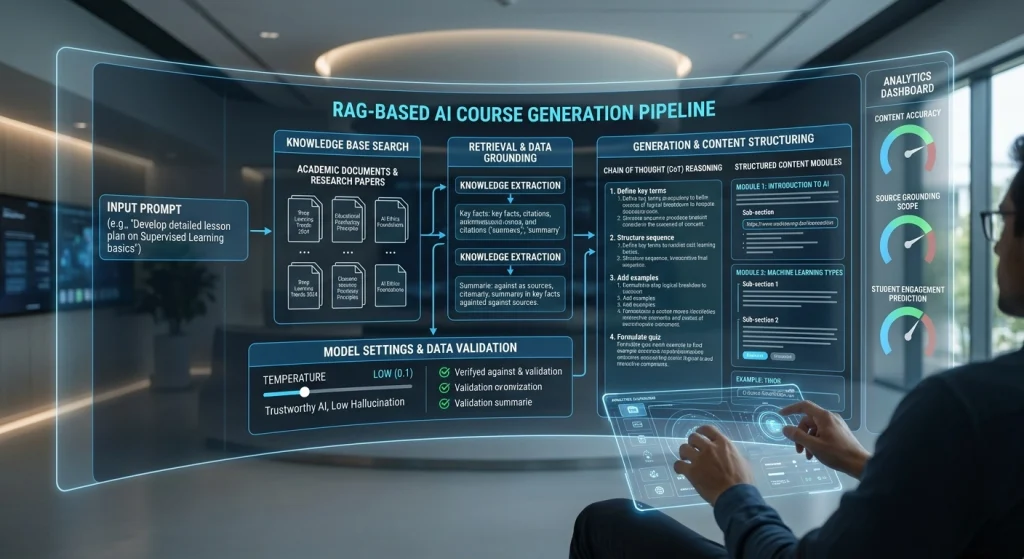
- Retrieval-Augmented Generation (RAG): Tools employing RAG ground AI-generated content in specific, trusted source documents. This method ensures that the AI extracts and structures content directly from uploaded materials like PDFs, research papers, or handbooks, significantly reducing the risk of fabrication. Some platforms, like X-Pilot, use RAG to achieve “zero hallucinations” by grounding content in uploaded documents.
- Prompt Optimization: Crafting clear, specific, and detailed prompts is crucial. Providing context, requesting sources, breaking down complex topics, and controlling the output format can guide the AI toward more reliable responses. Techniques like “Chain-of-Thought (CoT) Prompting,” where the AI is instructed to reason step-by-step, can improve accuracy by up to 30% in complex tasks.
- Fine-Tuning Models with Quality Data: Training AI models on diverse, representative, and high-quality educational resources, such as academic journal articles and textbooks, can improve performance and reduce hallucinations. Regularly updating training data is also essential to prevent outdated responses.
- Temperature Control: Adjusting the AI’s “temperature” to a lower value (e.g., 0.3-0.5 for factual tasks) can reduce the likelihood of creative or speculative responses that might be inaccurate.
Implementing Human-Centric Safeguards
- Subject-Matter Expert Review: Regardless of the AI tool used, a thorough review by subject-matter experts before publishing is indispensable. This human oversight acts as the final check for accuracy and relevance.
- Fact-Checking and Cross-Verification: Educators and students should be coached to fact-check AI responses and compare them with credible sources. Tools like PDF.ai, for instance, provide direct citations to specific pages in source documents, enabling easy verification.
- AI Literacy Training: Equipping both educators and students with AI literacy skills is vital. This includes understanding AI’s limitations, recognizing potential biases, and knowing how to effectively leverage AI as a helper rather than a shortcut. As Benjamin Riley, founder and CEO of Cognitive Resonance, notes, “I want people to be critical thinkers about this technology.”
Conclusion: Building the Future of Trustworthy Academic Content
The integration of AI into course creation offers unprecedented opportunities for efficiency and personalization in education. However, the challenge of AI hallucinations necessitates a proactive and thoughtful approach to ensure AcademicOS hallucination free course creation and trusted AI for academic content. By combining advanced AI techniques like RAG and prompt optimization with critical human oversight and comprehensive AI literacy, we can build a future where academic content is not only intelligently generated but also unfailingly accurate and reliable. This commitment to accuracy will foster deeper learning, uphold academic integrity, and ultimately empower a new generation of informed and critical thinkers.
Frequently Asked Questions (FAQ)
-
Q: What exactly is an AI hallucination in the context of course creation?
A: An AI hallucination in course creation refers to instances where an AI model generates content that seems plausible but is factually incorrect, irrelevant, or not supported by the data it was trained on or given as a source.
-
Q: How can I ensure the AI tool I’m using for course creation is trustworthy?
A: Look for tools that utilize Retrieval-Augmented Generation (RAG) to ground content in your uploaded source documents, rather than relying purely on LLM generation. Always implement a subject-matter expert review workflow and prioritize tools that offer high accuracy guarantees, such as Mini Course Generator’s claim of 95% accuracy.
-
Q: Can AI tools help with creating assessments without errors?
A: Many AI course creators can generate quiz questions based on course content. However, the final quality of quizzes and assessments still requires educator review to ensure accuracy and alignment with learning objectives.
About the Author

CEO | Education & Tech Platforms | Institution Builder | AI for Learning & Governance | Driving Scalable Education Solutions