Ask any curriculum committee what eats their year, and the answer is rarely teaching. It is the slow, manual work of mapping outcomes, aligning courses to accreditation frameworks, drafting content, and pushing everything through approvals. Generic AI tools promise to speed this up, but most academic leaders hesitate for a good reason: an AI that invents facts has no place in a university syllabus. We have written before about why AI hallucination is a serious risk in education — and why grounding is the answer.
That is exactly the problem AcademicOS Studio was built to solve.
What Is AcademicOS Studio?
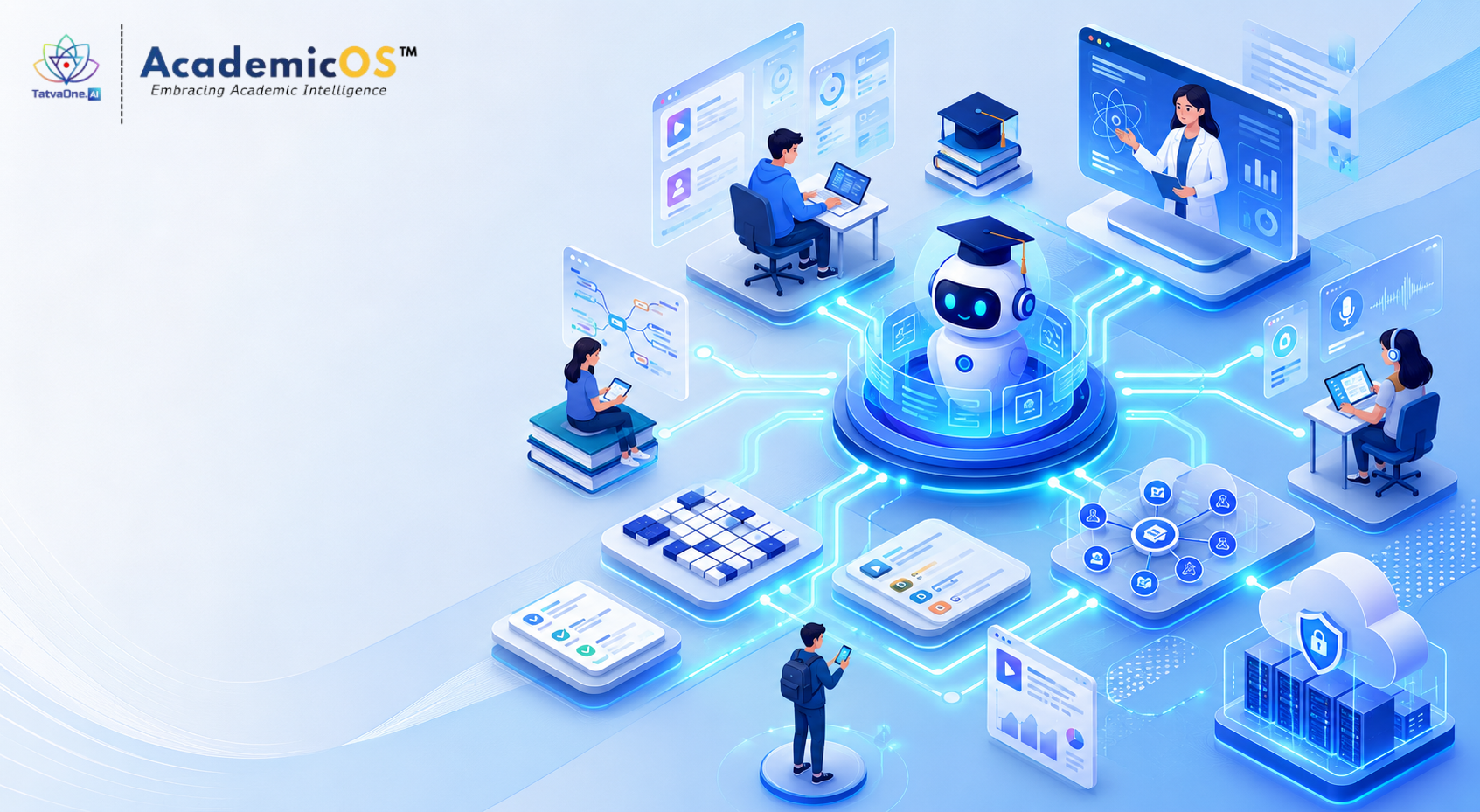
AcademicOS Studio is an AI-powered curriculum and content development platform that enables universities and educational institutions to design standards-aligned curricula, generate academically grounded content, build assessments, and support students — all within one integrated platform. Its promise is simple: Design. Develop. Deliver. One connected workflow runs from curriculum to content, assessment, classroom, student learning, examination, and analytics.
Curriculum That Meets Global Academic Standards
Everything starts with structure. AcademicOS Studio generates curricula across the full Programme → Course → Module → Unit → Topic hierarchy, with Learning Outcomes, Course Outcomes, and Programme Outcomes created automatically and mapped end to end (CLO–PLO), aligned to Bloom’s cognitive levels. Nothing is published until it passes a validation workflow and Subject Matter Expert approval.
Because institutions answer to different regulators, the platform is standards-native out of the box. It supports UGC and NEP 2020, AICTE, NMC, ABET, AACSB, Bologna/ECTS, QAA UK, WFME, CDIO, and more — alongside multiple taxonomy frameworks including Revised Bloom’s, ECTS, UK QAA/FHEQ, and the Carnegie Framework. The result is outcome-based education with complete traceability, ready for accreditation review.
Grounded Content, Not Guesswork
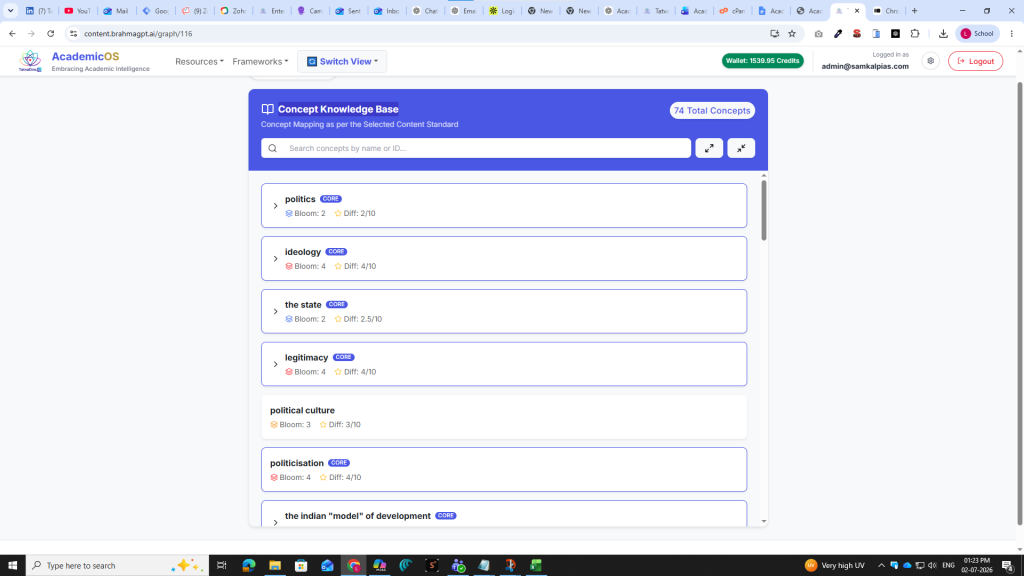
This is where AcademicOS Studio departs from generic AI tools. Instead of drawing on the open internet, it generates content exclusively from institution-approved reference materials. Every approved textbook is analysed into a Concept Knowledge Base (CKB) — a structured map of concepts, relationships, and cognitive levels — which then powers accurate, source-grounded generation.
From that foundation, faculty can produce complete instructional assets:
- Learning objectives, concept explanations, and worked examples
- Case studies, practice problems, and summaries
- Tables, diagrams, and datasets
- LaTeX mathematical content with STEM-ready academic formatting
Finished materials export directly as DOCX, PDF, or LMS-ready packages — a genuinely different model from conventional course production. If you are weighing that shift, our comparison of Curriculum-as-a-Service versus traditional eLearning development breaks down the economics.
Faculty Stay in Control
AI accelerates the work; it does not replace judgement. Every curriculum, lesson, assessment, and learning asset is reviewed, refined, and approved by Subject Matter Experts before publication. Role-based governance gives tenant administrators, Centres of Excellence, faculty, SMEs, and students structured workflows with approval gates at every stage — human-in-the-loop by design, not as an afterthought.
A Complete Academic Ecosystem
AcademicOS Studio extends well beyond content creation. The Classroom workspace generates lecture notes, presentations, and faculty resources. ExaminationOS builds blueprint-driven question banks with Bloom’s alignment, marking schemes, and answer keys. AskOS, a 24×7 AI teaching assistant available on web and Telegram, gives students curriculum-grounded support and instant concept clarification. Proctorly runs secure digital examinations with scheduling, administration, and result tracking. An interactive Knowledge Graph reveals concept dependencies and curriculum gaps, while Evidence Dashboards make coverage, source grounding, Bloom’s distribution, and outcome traceability exportable for review.
Who Is It For?
Universities, autonomous colleges, online and distance learning providers, certification bodies, corporate L&D teams, and academic publishers are all using this model to modernise how learning is built. The conversation is gathering pace across the sector — we shared how institutions are responding at the ET Education Summit 2026.
Build Better Curriculum. Deliver Better Learning.
If your institution is ready to move from fragmented tools and manual mapping to one governed, standards-aligned platform, see AcademicOS Studio in action. Book a demo with the TatvaOne.AI team and watch a curriculum go from approved textbook to classroom-ready in a single workflow.
About the Author

CEO | Education & Tech Platforms | Institution Builder | AI for Learning & Governance | Driving Scalable Education Solutions