

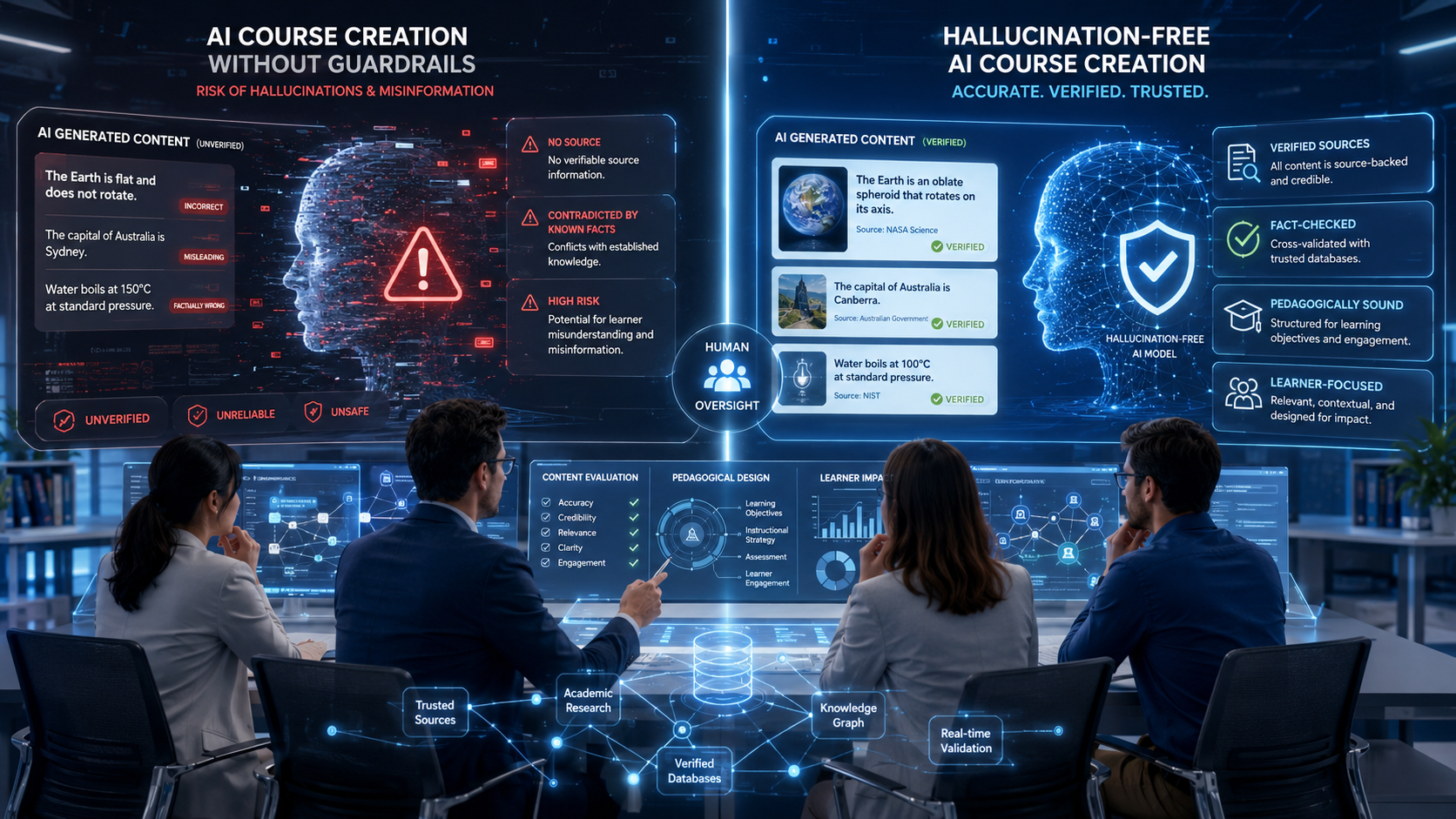
Introduction: The Real Risk of AI-Generated Course Content
There is a specific kind of panic that hits when a faculty member, curriculum designer, or corporate L&D lead opens an AI-generated module and finds a confident, well-formatted, completely incorrect explanation of a core concept.
- The formatting is clean.
- The paragraph structure is polished.
- The content sounds authoritative.
But the content is wrong.
Not casually wrong. Not stylistically weak. Wrong in the way that can mislead a student, weaken a learning outcome, distort a compliance procedure, or send an employee into a task with the wrong understanding.
This is the hallucination problem. In most general AI use cases, hallucination is inconvenient. In academic and corporate learning, it is a credibility risk.
However, hallucination is only one part of the problem. In structured learning content, there are other failures that are more subtle but equally dangerous: faithfulness failure, grounding drift, semantic drift, and context dilution.
These failures may not always look like hallucination. The content may remain topically related to the reference material. It may even sound correct. But it may still lose the meaning, intent, level, emphasis, or instructional purpose of the source.
That is why trusted AI course creation cannot depend only on a powerful LLM. It requires a structured content architecture, a controlled knowledge base, source-grounded generation, and quality assurance built directly into the content generation workflow.
This is where AcademicOS takes a different approach.
Table of Contents
What Hallucination Means in AI Course Creation
An AI model hallucinates when it generates content that is factually incorrect, fabricated, unsupported, or presented with confidence despite not being grounded in the approved reference material.
In a general-purpose chatbot, hallucination is a known limitation. Users may verify the answer. They may ask follow-up questions. The stakes are often manageable.
In academic and corporate learning, the stakes are much higher.
When AI generates content for pharmacology, law, engineering, financial compliance, cybersecurity, regulatory training, internal SOPs, teacher education, nursing, or management programs, the acceptable standard is not “mostly correct.”
The standard is:
Accurate. Source-grounded. Outcome-aligned. Reviewable. Traceable.
A course module is not just information. It becomes part of a learning journey. Students may be assessed on it. Employees may act on it. Institutions may report it for accreditation. Companies may rely on it for compliance training.
That is why hallucination-free AI course creation must be treated as an architectural requirement, not as a marketing phrase.
Why Hallucination Is Not the Only Problem
Many AI-generated learning materials do not contain obvious hallucinations. They may not invent facts. They may not fabricate references. They may not produce completely false statements.
Yet they can still be academically or operationally weak.
This happens because LLMs do not simply copy reference material. They interpret, compress, expand, rephrase, and synthesize. While doing this, they may unintentionally change the meaning of the source.
This is especially risky when the source material includes:
- Learning Outcomes, Course Outcomes, Program Outcomes, or Program Specific Outcomes
- Bloom’s Taxonomy levels
- Competency frameworks
- Compliance procedures
- Legal or regulatory language
- Technical definitions
- Internal process documentation
- Assessment rubrics
- Domain-specific terminology
- Institutional curriculum requirements
In these cases, even a small shift in wording can change the instructional meaning.
For example:
“critique a policy decision” is not the same as “understand a policy decision.”
“Apply Newton’s laws to real-world systems” is not the same as “learn the basics of physics.”
“Follow the approved escalation procedure” is not the same as “take appropriate action.”
The words may sound similar. The educational meaning is not.
This is where four additional risks become important.

1. Faithfulness Failure: When the AI Is Not Fully Loyal to the Source
Faithfulness failure occurs when AI-generated content does not remain fully faithful to the provided reference material.
The response may be fluent. It may be logical. It may even be broadly correct. But it changes the intent, emphasis, or meaning of the original source.
Example
Reference material:
“The assessment should evaluate conceptual understanding rather than memory recall.”
AI-generated output:
“The assessment should evaluate conceptual understanding and factual recall.”
This may look harmless, but it changes the academic intent. The source was specifically moving away from memory recall. The AI response reintroduced it.
That is not a classic hallucination. It is a faithfulness failure.
Why this matters in education
In academic content generation, faithfulness failure can affect:
- LO and CO interpretation
- Assessment blueprinting
- Rubric design
- Question generation
- Topic explanations
- Skill mapping
- Accreditation evidence
- Course-level consistency
When content is not faithful to the source, the institution loses control over curriculum intent.
For corporate L&D, the risk is equally serious. A compliance module that slightly changes the meaning of a policy can create operational confusion and audit risk.
2. Grounding Drift: When the AI Moves Away from the Reference Material
Grounding drift happens when the AI starts with the provided material but gradually moves toward its own general knowledge, generic writing patterns, or broad assumptions.
The output may still be related to the topic, but it is no longer tightly grounded in the approved source.
Example
Reference material:
“CO1 focuses on applying Newton’s laws to real-world mechanical systems.”
AI-generated output:
“CO1 introduces learners to physics concepts such as motion, force, energy, and matter.”
The AI-generated version sounds acceptable, but it has drifted. The original CO was about applying Newton’s laws to mechanical systems. The response has expanded into a generic physics introduction.
This is grounding drift.
Why grounding drift is dangerous
Grounding drift is especially common when AI generates:
- Unit-wise explanations
- Chapter summaries
- Lesson scripts
- Assessment questions
- Learning activities
- Question feedback
- Rubrics
- Corporate training modules
The content remains polished, but it becomes less specific to the curriculum, organization, or approved reference material.
For AI course generation, this is a major problem because institutions and enterprises do not need generic content. They need content that is aligned to their specific curriculum, their specific competency framework, and their approved knowledge sources.
3. Semantic Drift: When the Meaning Changes During Rephrasing
Semantic drift occurs when the meaning of the source changes during paraphrasing or summarization.
This is one of the most serious risks in AI-generated academic content because learning design depends heavily on precise wording.
Example
Reference material:
“Students will critique policy decisions using constitutional principles.”
AI-generated output:
“Students will understand constitutional principles and government policies.”
The second version is not necessarily false. But it changes the cognitive level.
“Critique” is higher-order thinking.
“Understand” is lower-order comprehension.
In Bloom’s Taxonomy terms, this is a major instructional downgrade.
Why semantic drift matters
Semantic drift can damage:
- Bloom’s Taxonomy alignment
- Learning outcome mapping
- Competency mapping
- Assessment validity
- Question difficulty calibration
- Rubric accuracy
- Program outcome reporting
For example, if a course outcome expects analysis but the generated content only supports recall, the learner may not be prepared for the intended assessment. Similarly, if a corporate training objective expects decision-making but the content only explains definitions, the training will not build the required capability.
Semantic drift is not always visible in a quick review. That is why AI-generated content needs structured QA checks, not just manual reading.
4. Context Dilution: When Generic Explanation Weakens the Original Intent
Context dilution happens when the AI adds too much general explanation around the source material and weakens the specific context.
This often happens when the AI tries to make content more readable, more comprehensive, or more “student-friendly.”
Example
A reference document may describe a specific compliance procedure for a company’s internal data privacy workflow. The AI may convert it into a broad explanation of data privacy principles.
The output may be educational, but it no longer serves the operational purpose.
In academia, a curriculum may be specific to NEP 2020, NAAC, NBA, ABET, AACSB, or an institution’s internal academic framework. If AI turns that into a generic discussion of “quality education,” the original context is diluted.
Why context dilution matters
Context dilution weakens:
- Institutional specificity
- Regulatory specificity
- Accreditation alignment
- Course identity
- Faculty intent
- Learner relevance
- Workplace applicability
In AI course creation, more content is not always better content. A longer explanation can actually reduce accuracy if it moves away from the intended context.

Why Standard AI Course Creation Tools Fall Short
Most AI-powered eLearning authoring tools follow a simple workflow:
A user enters a topic or outline with reference material
The tool sends the prompt to a general LLM.
The LLM generates a module, quiz, script, or slide deck.
The user reviews the output manually.
This approach may be useful for generic content creation, but it is weak for serious academic and corporate learning.
The problem is not only that the LLM may hallucinate. The deeper problem is that the generation is often not anchored to a controlled academic or organizational knowledge base.
The model may draw from broad internet-scale patterns, outdated training data, generic examples, and its own internal assumptions. Even when documents are uploaded, the model may still use pretrained knowledge while rephrasing or expanding the content.
That is where hallucination, faithfulness failure, grounding drift, semantic drift, and context dilution enter the workflow.
For evergreen topics with low risk, this may be acceptable. For structured learning, compliance training, curriculum-aligned assessment, or outcome-based education, it is not.
What Hallucination-Free and Drift-Resistant Course Creation Requires
A serious AI course creation system must be designed differently.
It should not simply ask the AI to “write a course.” It should control what the AI can use, how it interprets the material, how content is structured, and how quality is checked.
A trusted system requires four things:
- A curated and controlled knowledge base
- Outcome-aware content generation
- Integrated QA during generation
- Human expert review and traceability
This is the foundation of AcademicOS.
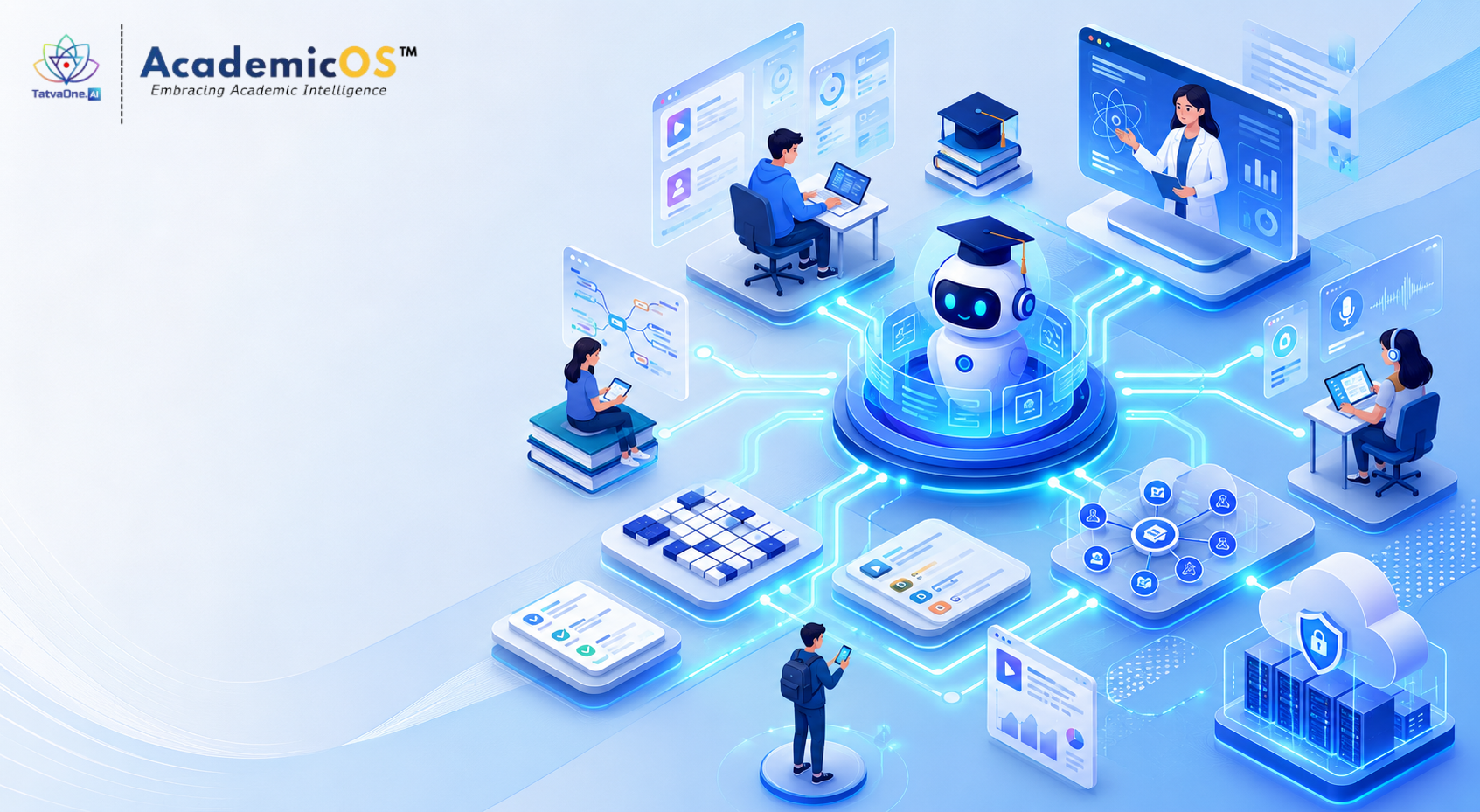
How AcademicOS Handles This: Curriculum to CKB to Section-Wise Content Generation
AcademicOS is built around a structured content intelligence workflow.
Instead of treating AI content generation as a one-step prompt response, AcademicOS breaks the process into controlled stages:
Curriculum → Concept Knowledge Base → Section-wise Content Generation → QA Check → Expert Review → Approved Content
This approach reduces hallucination and also addresses the more subtle risks of faithfulness failure, grounding drift, semantic drift, and context dilution.
Step 1: Curriculum and Reference Material Ingestion
The process begins with source material.
AcademicOS can work with:
- Curriculum documents
- Syllabi
- Course outlines
- Reference books
- Faculty notes
- Approved institutional content
- External reference links
- OER materials
- Corporate SOPs
- Compliance manuals
- Product documentation
- Training frameworks
The key point is that AI generation begins from approved material, not from a blank prompt.
This gives the system a controlled source boundary.
Instead of asking the LLM to generate from broad knowledge, AcademicOS first establishes what the course or training program is actually based on.
Step 2: Concept Knowledge Base Creation
Once the curriculum and reference materials are ingested, AcademicOS structures them into a Concept Knowledge Base, or CKB.
The CKB is not just a file repository. It is a structured academic and conceptual layer that identifies:
- Units
- Modules
- Topics
- Subtopics
- Concepts
- Definitions
- Learning objectives
- Course outcomes
- Concept relationships
- Prerequisite concepts
- Reference grounding
- Cognitive level indicators
- Assessment relevance
This is where AcademicOS moves beyond generic AI content generation.
The CKB acts as the foundation for source-grounded, curriculum-aware generation. It ensures that every generated section is connected to specific concepts, curriculum elements, and approved references.
Step 3: LO, CO, PO, PSO, and Competency Mapping
For academic institutions, AcademicOS can support mapping across:
- Learning Outcomes
- Course Outcomes
- Program Outcomes
- Program Specific Outcomes
- Bloom’s Taxonomy levels
- Concept mastery indicators
- Assessment criteria
For corporate L&D, the same architecture can support:
- Competency mapping
- Skill mapping
- Role-based training outcomes
- Compliance objectives
- Department-specific training goals
- Performance-linked learning outcomes
This matters because content should not be generated in isolation. A topic explanation should know what outcome it serves. A question should know which concept it assesses. A rubric should know what performance level it is evaluating.
Outcome-aware generation helps prevent semantic drift because the system is not only checking whether the content is about the right topic. It is checking whether the content preserves the intended learning level.
Step 4: Section-Wise Content Generation
After the CKB is created, AcademicOS generates content section by section.
This is important.
A full course generated in one pass is more likely to drift, generalize, skip concepts, or dilute context. Section-wise generation creates better control.
Each generated section can be tied to:
- A specific unit
- A specific concept
- A specific learning outcome
- A specific reference source
- A specific cognitive level
- A specific content purpose
For example, AcademicOS can generate:
- Concept explanations
- Unit-wise content
- Topic summaries
- Examples and case studies
- Learning checks
- Assessment questions
- Rubrics
- Feedback explanations
- Faculty notes
- Learner-facing study material
- Corporate training modules
- Scenario-based learning activities
Because the generation is section-wise and CKB-grounded, the system can check whether each output remains faithful to the source and aligned to the intended outcome.
Step 5: Integrated QA Check During Content Generation
This is one of the most important parts of the workflow.
In many AI authoring tools, quality assurance happens after the content has already been generated. Someone reads the module and decides whether it is acceptable.
AcademicOS treats QA as part of the generation process itself.
The QA layer can check for:
- Source faithfulness
- Grounding consistency
- Concept coverage
- Missing concepts
- Unsupported claims
- Semantic drift
- Outcome alignment
- Bloom’s level alignment
- Context dilution
- Reference traceability
- Terminology consistency
- Assessment-content alignment
- Rubric-question alignment
This means the system is not only generating content. It is evaluating whether the generated content remains aligned with the curriculum, CKB, and reference material.
How AcademicOS Reduces Faithfulness Failure
Faithfulness failure is reduced by checking whether generated content preserves the meaning, emphasis, and intent of the source.
AcademicOS does this by comparing generated sections against the relevant CKB concepts and source references.
For example, if the curriculum says that a learner must “evaluate,” the generated content should not reduce that to “describe.” If the reference material excludes a particular interpretation, the generated content should not reintroduce it.
The QA process helps identify where the AI has produced content that is fluent but not faithful.
How AcademicOS Reduces Grounding Drift
Grounding drift is reduced by keeping generation tied to the CKB and reference-linked concepts.
Instead of allowing the model to freely expand into general knowledge, AcademicOS generates within a structured content boundary.
The system can flag content that:
- Introduces unsupported ideas
- Moves beyond the source scope
- Uses generic explanations instead of curriculum-specific explanations
- Adds examples that are not aligned with the approved material
- Overgeneralizes a specific topic
This is especially useful in specialized academic and corporate contexts where generic AI explanations can weaken the value of the content.
How AcademicOS Reduces Semantic Drift
Semantic drift is reduced through outcome-aware generation and QA checks.
AcademicOS can evaluate whether the generated section preserves:
- The intended cognitive level
- The action verb
- The scope of the learning outcome
- The assessment expectation
- The skill or competency being developed
For example, if a Course Outcome requires “analysis,” the content and assessments should support analysis, not merely recall.
This is critical in OBE-driven academic environments, where LO, CO, PO, and PSO alignment must be demonstrated. It is equally important in corporate L&D, where training must map to actual workplace competencies.
How AcademicOS Reduces Context Dilution
Context dilution is reduced by generating content from the institution’s or organization’s own knowledge base.
AcademicOS does not treat every course as a generic subject. It treats each course or training program as a structured knowledge project.
This allows content to remain specific to:
- The institution’s curriculum
- The approved references
- The regulatory or accreditation context
- The target learner group
- The required competency framework
- The assessment model
- The corporate process or policy
The result is content that is not only readable, but relevant.
Why Traceability Matters
Trusted AI content must be traceable.
If a faculty member, auditor, accreditor, compliance officer, or client asks where a particular explanation came from, the platform should be able to answer.
AcademicOS supports this by maintaining links between generated content and its underlying sources, CKB concepts, outcomes, and references.
Traceability matters because educational and corporate content cannot be defended by saying, “The AI generated it.”
The correct answer must be:
“This content was generated from approved reference material, mapped to defined outcomes, checked for grounding and alignment, reviewed through QA, and approved through the content workflow.”
That is the difference between AI-generated content and trusted AI-generated content.
Human-in-the-Loop Review Still Matters
Hallucination-free does not mean human-free.
In serious learning environments, expert validation remains essential.
Faculty members, instructional designers, subject matter experts, compliance reviewers, and L&D leads must be able to review, correct, approve, and version content.
AcademicOS is designed to support this human-in-the-loop model. The AI accelerates generation and structuring, but the expert remains responsible for academic or organizational approval.
This creates accountability.
When a student, auditor, regulator, or client questions the content, the organization can demonstrate not only that AI was used, but that AI was used within a controlled and reviewable process.
The Organizational Risk of Ignoring These Problems
The risk of poor AI content generation is not limited to one wrong paragraph.
The real risk is loss of trust.
- A faculty member finds one serious error and starts doubting the entire AI workflow.
- An L&D team discovers that compliance content has been generalized and stops relying on AI-generated modules.
- An auditor asks for source traceability and the team cannot provide it.
- A learner challenges an assessment question because it does not match the taught content.
- A corporate trainee follows an inaccurate process explanation.
Once trust is broken, teams begin checking everything manually. At that point, the efficiency benefit of AI disappears.
This is why AI course creation must be designed for trust from the beginning.

What Trusted AI for Academic and Corporate Content Looks Like
Trusted AI for content creation is not about using the most impressive general-purpose model. It is about using the right architecture.
A trusted system should provide:
- A controlled knowledge base owned by the institution or organization
- Curriculum-to-concept structuring
- CKB-based content generation
- Outcome-aware generation
- Section-wise content control
- Integrated QA checks
- Source traceability
- Version control
- Expert review workflows
- Accreditation and compliance support
- Assessment and rubric alignment
This is the difference between AI that writes content and AI that supports academic and organizational knowledge systems.
AcademicOS is built around this second model.
Questions to Ask Before Choosing an AI Course Creation Platform
When evaluating AI course creation tools, institutions and enterprises should ask direct questions.
Where does the AI draw its content from?
If the answer is a general LLM or internet-trained model, the risk is not fully managed. The better answer is a curated, organization-controlled knowledge base.
Does the platform create a Concept Knowledge Base?
A CKB helps structure curriculum and references into concepts, outcomes, relationships, and source-grounded knowledge units.
Is content generated section by section?
Section-wise generation allows better control, review, and QA than one-shot course generation.
How does the system detect faithfulness failure?
The platform should check whether generated content preserves the meaning of the source.
How does the system reduce grounding drift?
The platform should prevent AI from moving into unsupported or generic explanations.
How does the system detect semantic drift?
The platform should check whether the intended learning level, outcome, and cognitive expectation are preserved.
How does the system prevent context dilution?
The platform should keep content specific to the institution, curriculum, learner group, compliance framework, or organizational context.
Is QA built into the generation process?
QA should not be an afterthought. It should be integrated into the content pipeline.
Can the content be traced back to source material?
Every generated section should be explainable, reviewable, and auditable.
What happens when AI output is wrong?
The platform should support correction, expert override, versioning, and re-generation.
.
The Bigger Picture: From AI Content Generation to AI Content Governance
The future of AI in education and corporate learning is not simply faster content creation.
The real future is content governance.
Institutions and enterprises need systems that can generate content, but also control, verify, align, review, and audit that content.
This is especially important as AI becomes part of:
- Curriculum development
- OBE implementation
- Question bank generation
- Assessment blueprinting
- Digital evaluation
- Corporate training
- Compliance learning
- Skill development
- Workforce readiness
- Accreditation reporting
In all these areas, content must be more than fluent. It must be trustworthy.
Conclusion: The Goal Is Not Impressive AI Output. The Goal Is Trusted Learning Content.
Hallucination-free course creation is not just about avoiding fabricated facts.
It is also about preventing faithfulness failure, grounding drift, semantic drift, and context dilution.
A generated module can look polished and still lose the essence of the reference material. It can sound academic and still fail to preserve the intended learning outcome. It can be readable and still be misaligned with the curriculum.
That is why trusted AI course creation requires a structured workflow.
AcademicOS addresses this through a Curriculum-to-CKB-to-section-wise content generation process, supported by integrated QA checks, source grounding, outcome mapping, expert review, and traceability.
The goal is not to make AI write more content.
The goal is to create content that faculty trust, learners rely on, organizations can stand behind, and auditors can verify.
That is the real standard for AI-generated academic and corporate learning content.
Ready to see how hallucination-resistant and drift-aware AI course creation works with your own curriculum or training material?
Book a demo with the AcademicOS team.
Bring a real course, syllabus, reference document, training manual, or competency framework, and see how AcademicOS converts it into a structured CKB, generates section-wise content, and applies QA checks for source grounding, outcome alignment, and content trust.
About the Author

CEO | Education & Tech Platforms | Institution Builder | AI for Learning & Governance | Driving Scalable Education Solutions

Alex Chen
June 30, 2026Très bon article ! J’utilise Free Image Generator sur pour ce type de besoin. Free Image Generator