Rethinking corporate learning around employee capability, not course completion.
At a Glance
In one line. Course completion proves that training was delivered; it does not prove that an employee is ready to do the job. Upskill LXP measures readiness, not just completion.
Key points in this paper:
- Completion is a delivery metric, not a capability metric. A green dashboard can still hide real skill gaps.
- Workforce readiness needs four things: engagement, retention, practical validation, and analytics.
- Upskill LXP is a Learning Experience Platform (LXP) that turns internal knowledge into learning journeys and measures capability.
- The Role Readiness Index replaces “Did they finish?” with “Are they ready?” by combining completion, assessment, retention, and practical validation.
- Grounded content. Courses are built from your approved material, using the same AcademicOS content approach behind Studio, AskOS, and CaaS.
Executive Summary
For most of the last two decades, corporate learning has been measured by a single, convenient number: the completion rate. An employee opens a module, works through the content, passes a quiz, and receives a certificate. The learning management system marks the record complete, the dashboard turns green, and everyone moves on. It is a tidy way to report activity. It is a poor way to understand capability.
Every CHRO, HR leader, and L&D head already knows the uncomfortable truth behind the green dashboard. A completed course does not guarantee that knowledge was retained, that the skill can be applied on the job, or that a manager could vouch for the person’s readiness if asked. Completion measures that training was delivered. It says almost nothing about whether the workforce is actually ready.
This white paper explains why the completion metric has quietly become a liability, what workforce readiness genuinely requires, and how Upskill LXP — an AI-powered Learning Experience Platform for corporate learning, employee development, compliance, and internal certification — closes the gap between finishing a course and being ready to perform.
Training should not end with completion. It should lead to capability.
Table of Contents
Does Training Completion Mean an Employee Is Workforce-Ready?
No. Completion confirms that training was delivered and that a learner reached the end of the content. It does not confirm that the knowledge was retained, can be applied at work, or has been validated by a manager.
Completion became the industry’s default metric for understandable reasons. It is objective, easy to capture, and simple to roll up into a board-ready percentage. When a regulator asks whether mandatory training was delivered, a completion report is exactly the evidence required. The problem is not that completion is measured; it is that completion is mistaken for the outcome, when it is only the starting line.
Consider what a completion record actually certifies. It confirms that a person reached the end of a piece of content and, usually, answered enough multiple-choice questions correctly on a single attempt. It does not.
confirm that the knowledge survived the week, that it can be recalled under pressure, or that it changes behaviour at work. A sales representative can complete a negotiation course and still freeze in a live deal. An operator can pass a safety quiz and still skip a step on the floor. The certificate is real; the readiness is unproven.
This gap carries costs that rarely appear on the learning dashboard. Compliance exposure persists even after “100% complete,” because completion is not competence. Onboarding stretches longer than planned because new hires finished the modules but cannot yet do the job. Managers lose trust in learning data because it does not match what they see in performance. And L&D teams, asked to prove impact, are left defending activity numbers that were never designed to answer the question being asked.
Completion is not the same as capability. The certificate measures that training happened. Readiness measures whether it worked.
What Is Workforce Readiness?
| KEY DEFINITION Workforce readiness — the point at which an employee has not only completed training but has retained the knowledge, can apply it in real work, and can have that capability validated by a manager or subject-matter expert. |
If completion is the wrong finish line, the right questions are the ones people leaders actually ask — and none of them can be answered by a completion percentage:
- Retention: Did the employee retain the knowledge weeks and months later, not just on the day of the quiz?
- Application: Can they apply it in the messy conditions of real work, not just a controlled assessment?
- Validation: Can their manager confirm the skill, based on observed evidence rather than a system flag?
- Visibility: Can HR see capability and gaps across teams, roles, and locations?
- Proof: Can L&D show that training is producing measurable readiness, in language the business recognises?
These questions mark the shift from a completion mindset to a capability mindset — from activity reporting (how many courses were finished) to capability reporting (whether people are ready to perform). Making that shift is not a matter of adding another dashboard. It requires a platform designed to capture the signals completion ignores.
What Does Workforce Readiness Actually Require?
Readiness is the convergence of four things: engagement so learning is absorbed, reinforcement so it is retained, practical validation so skill is proven, and analytics so capability is visible.
1. Engagement, so learning is genuinely absorbed
Passive reading rarely produces durable learning. Readiness begins with active participation — learners making decisions and getting immediate feedback — rather than scrolling to the end of a document.
2. Reinforcement, so knowledge survives
The forgetting curve is unforgiving. Without deliberate reinforcement, much of what is learned fades within weeks. Readiness depends on bringing concepts back at the right intervals so they move from short-term exposure into long-term memory.
3. Practical validation, so skill is proven in context
Many workplace skills cannot be measured by a quiz. A completed task, an observed process, a handled customer, a submitted file these are the true tests of application. Readiness requires a way to capture that evidence and have a human confirm it.
4. Analytics, so capability is visible and provable
Finally, readiness has to be legible to the organisation. HR and L&D need to see role readiness, skill attainment, compliance status, and at-risk learners across the workforce — not as activity logs, but as a capability picture leaders can act on.
What Is Upskill LXP?
| KEY DEFINITION Upskill LXP — an AI-powered corporate Learning Experience Platform that helps organisations create, deliver, reinforce, validate, and measure employee learning — moving them from training completion to measurable workforce capability. It is powered by AcademicOS. |
Most organisations do not have a content problem. They already hold a deep well of institutional knowledge: SOPs, policies, product manuals, technical guides, safety instructions, onboarding documents, videos, and presentations. The real challenge is converting that knowledge into learning experiences that employees complete, remember, and apply — and then measuring whether readiness followed. That is what Upskill LXP is designed to do.
With Upskill LXP, an organisation turns internal knowledge into structured learning journeys and then supports the parts that actually create readiness: engagement, spaced repetition, practical submissions, internal certification, role-readiness scoring, and HR analytics. It is delivered as a white-labelled platform and built on the same curriculum-grounded content approach that powers AcademicOS — the model described in From Approved Textbooks to Classroom-Ready Courses.
Who is Upskill LXP built for?
Upskill LXP is designed around the real stakeholders in corporate learning, because readiness means something different to each of them:
- CHROs gain visibility into workforce capability, skill gaps, role readiness, compliance, and organisation-wide progress.
- HR heads manage employee development, mandatory training, certification, compliance reporting, and readiness analytics.
- L&D heads create courses faster, lift engagement, reinforce knowledge, and measure whether learning is effective.
- Line managers see team progress, at-risk learners, practical submissions, and the readiness of their people.
- Employees get a simple, engaging, personalised experience — lessons, quizzes, Brain Boost, XP, achievements, and certifications.
How Does Upskill LXP Close the Readiness Gap?
By covering the whole journey — create, deliver, engage, reinforce, validate, and measure — instead of stopping at delivery and completion tracking.
How does Upskill LXP create courses?
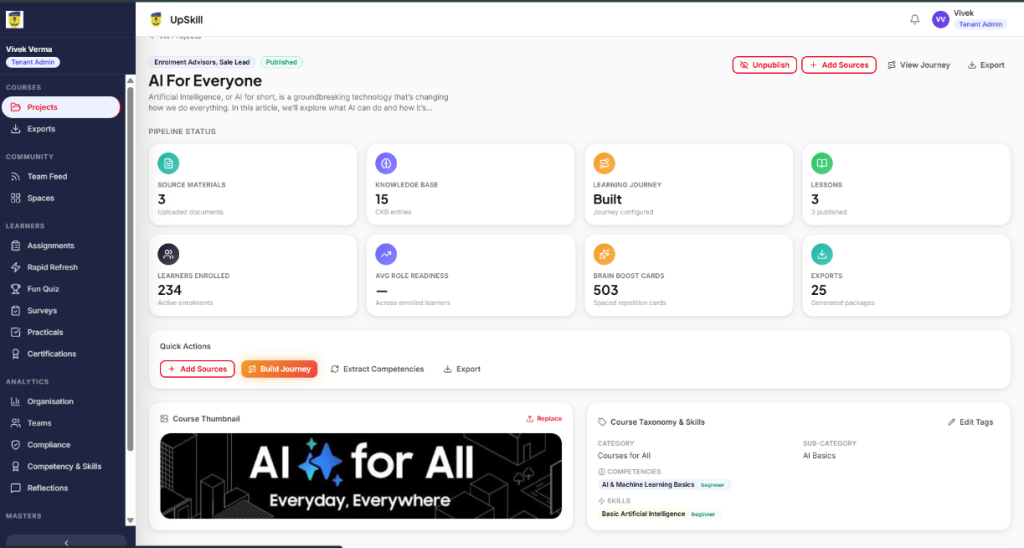
L&D teams create a training project, add source material, extract a structured knowledge base, build the learning journey, edit lessons, and publish to employees. The platform accepts documents, YouTube transcripts, web URLs, and open educational resources such as OER Commons. Rather than pulling generic material from the open internet, Upskill LXP builds courses from your approved sources — the same grounded, hallucination-resistant approach behind AcademicOS Content-as-a-Service (CaaS) — which keeps training connected to how your organisation actually works and cuts the time to stand up a structured programme.
How does Upskill LXP improve engagement?
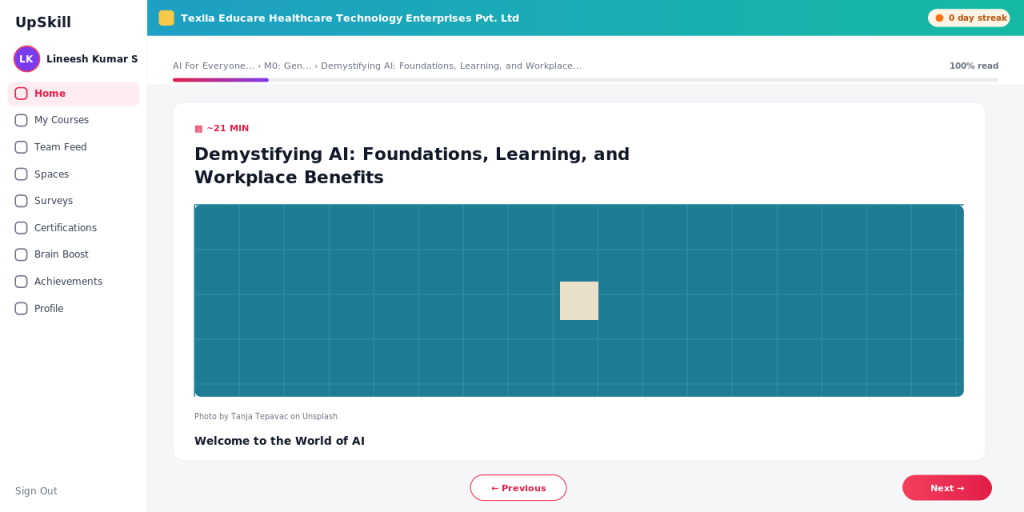
Upskill LXP is a learning experience platform, not a content repository. Employees land on a personalised dashboard — today’s lesson, active courses, recommended learning, Brain Boost flashcards, Rapid Refresh campaigns, and Fun Quiz sessions — with streaks and XP giving daily momentum a visible shape. The learning itself is built around participation: instead of only reading long documents, employees work through MCQs, scenarios, flip cards, drag-and-match exercises, reflections, and process-ordering activities. That active format is what makes the difference for onboarding, compliance, product and technical enablement, sales, and leadership development.
How does Upskill LXP improve knowledge retention?
Retention is where most corporate training quietly fails; an employee can finish a course today and lose the key concepts within weeks. Upskill LXP addresses this with Brain Boost, a spaced-repetition feature that brings important concepts back after a lesson is complete. Learners review flashcards and rate their confidence — Knew it, Almost, or Missed it — and the platform schedules the next review accordingly, anywhere from one day to ninety days out. Learning stops being a one-time event and becomes a managed path from short-term exposure to long-term memory.
How does Upskill LXP validate real workplace skills?
Training should not end at a certificate, because many skills can only be proven in context. Practicals let employees submit real-world evidence of application — a completed task, a workplace observation, a correctly followed process, a submitted file, a customer-handling scenario, a technical or operational activity — which is then reviewed by a line manager or SME reviewer. This is the step a quiz can never replace: it ties learning to actual workplace behaviour and puts a human validator in the loop.
What is the Role Readiness Index?
| KEY DEFINITION Role Readiness Index — a single measurable score in Upskill LXP that indicates whether a learner is progressing toward capability. It combines four signals — course completion, assessment performance, knowledge retention, and practical validation — instead of relying on completion alone. |
The Role Readiness Index is the heart of the platform’s answer to the completion problem. By blending multiple learning signals into one view, it changes the question HR and managers ask.
The question changes from “Has this employee completed the course?” to “Is this employee ready to apply the skill?” That shift is the whole point.
How does internal certification work?
For formal assessment, Upskill LXP includes Internal Certification Programs. Organisations create question banks, define pass thresholds, set time limits, configure attempt caps, and track performance. Question randomisation and answer shuffling reduce cheating risk across large cohorts, and assessments can be proctored through Proctorly.AI where integrity requirements are higher. This suits compliance certifications, product knowledge, technical readiness checks, sales enablement, operational training, internal academies, and role-based capability programmes.
What engagement tools are included?
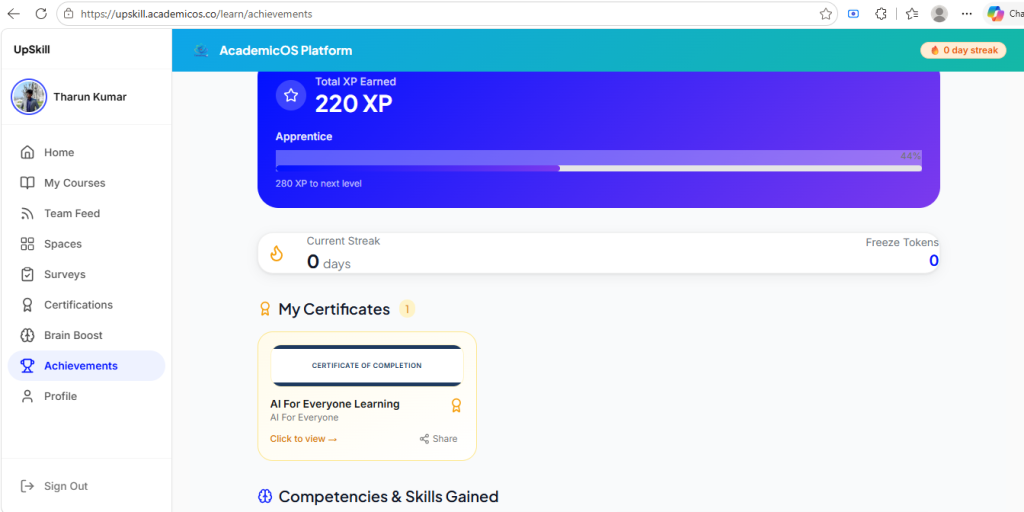
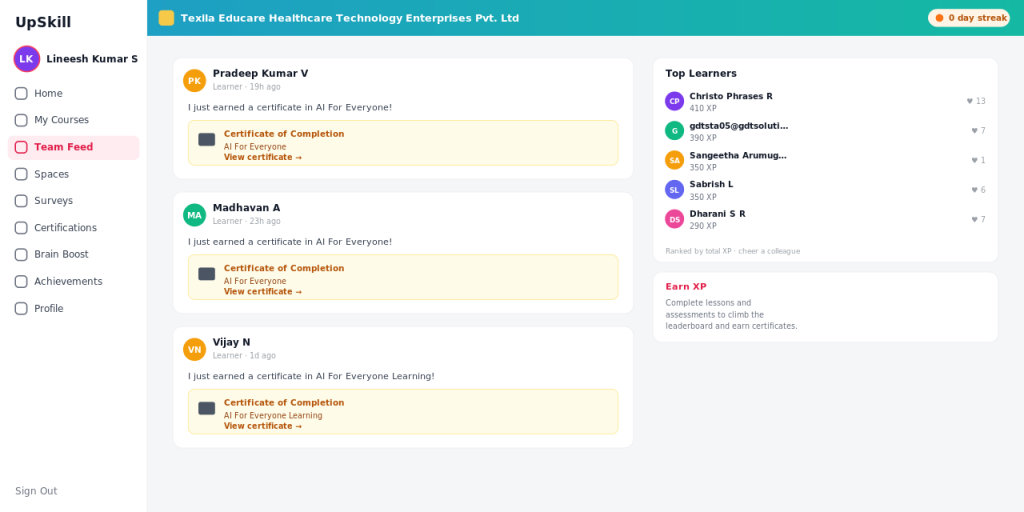
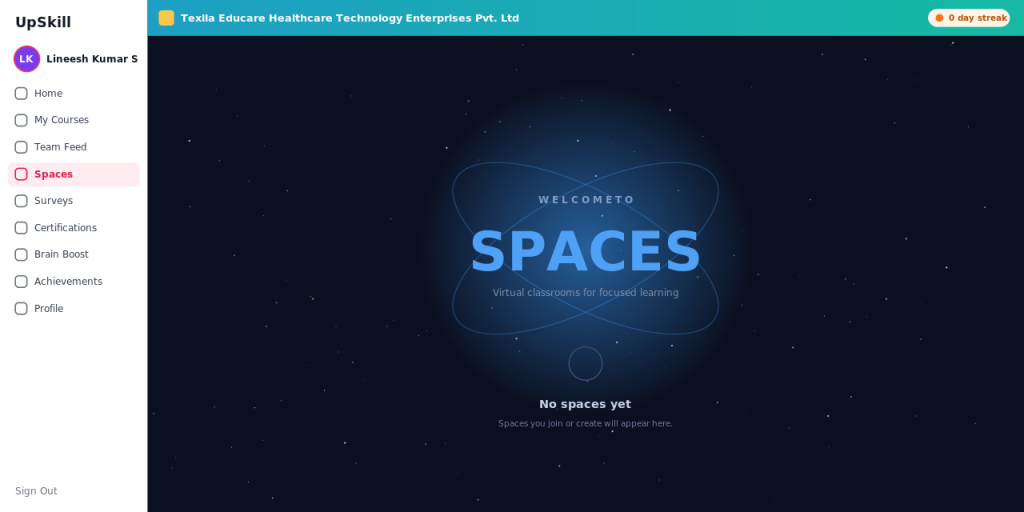
Readiness is not built in a single sitting, so Upskill LXP keeps learning active beyond the course. Rapid Refresh delivers short, targeted quizzes that reinforce knowledge across teams. Fun Quiz runs live, competitive sessions with leaderboards — well suited to team meetings and induction. Surveys capture feedback on training effectiveness. Practicals gather evidence of application, and Brain Boost sustains retention. A social layer reinforces all of it: a Team Feed where colleagues share earned certificates and cheer each other on, XP leaderboards that recognise top learners, and Spaces — focused virtual classrooms for specific cohorts.
What analytics does Upskill LXP provide?
Upskill LXP gives HR and L&D visibility across the full learning lifecycle. Leaders can track completion rates, role readiness, at-risk learners, assessment performance, skill attainment, competency progress, compliance status, practical validation, learner reflections, department-wise progress, and certification outcomes. The platform provides organization, team, compliance, and competency analytics, plus reflection exports, certification reports, and Rapid Refresh results a move from activity reporting to the capability reporting a CHRO actually needs.
LMS vs LXP: What’s the Difference?
A traditional LMS is built to administer, deliver, and track course completion. An LXP like Upskill LXP is built around the learner experience and the capability it produces — it asks not whether learning was completed, but whether learning created capability.
| Dimension | Traditional LMS | Upskill LXP |
|---|---|---|
| Core question | Was the course completed? | Is the employee ready to apply the skill? |
| Primary focus | Administration and delivery | Learner experience and measurable outcomes |
| Success metric | Completion rate | Role Readiness Index |
| Retention | Assumed after completion | Reinforced with Brain Boost spaced repetition |
| Workplace proof | Not captured | Practicals with manager / SME validation |
| Reporting for HR | Activity reporting | Capability and skill-gap reporting |
The distinction is not cosmetic. Each row above represents a signal that a completion-first system discards and a readiness-first platform captures. Together, they are the difference between reporting that training happened and proving that a workforce is ready.
Is Upskill LXP Enterprise-Ready?
Yes. Upskill LXP is built for organisational deployment — white-labelled branding, single sign-on, workflow integrations, and content grounded in your approved sources.
Companies configure their own branding, login page, email settings, certificate templates, departments, locations, competencies, roles, and user onboarding, so the platform reads as the company’s own learning environment rather than a third-party tool. It supports Microsoft SSO for onboarding and integrates with Slack and Microsoft Teams for nudges and digest alerts, so learning reaches employees where they already work.
Because content is grounded in approved organisational sources rather than the open internet, Upskill LXP avoids a risk that generic AI tools introduce — training that drifts away from, or contradicts, how the business actually operates. This is the same curriculum-locked principle behind AskOS, the curriculum-grounded AI learning platform, applied to the corporate context.
The Future of L&D Is Measurable Capability
The direction of corporate learning is not more content, a bigger course library, or another dashboard. It is measurable workforce capability. Getting there means supporting the full journey rather than only its first step — to create, deliver, engage, reinforce, validate, and measure. A platform that stops at delivery and tracking will always be answering yesterday’s question.
Upskill LXP is built for the whole journey and is live today as a corporate Learning Experience Platform for CHROs, HR leaders, L&D teams, managers, and employees — turning organisational knowledge into engaging learning, reinforcing it so it lasts, validating it against real work, and measuring it as readiness the business can act on.
Training should not end with completion. It should lead to capability. That belief is why Upskill LXP exists.
Frequently Asked Questions
-
Q: Does course completion mean an employee is job-ready?
A: No. Completion shows that training was delivered and finished. Readiness also requires that the knowledge was retained, can be applied at work, and can be validated by a manager or SME — which is what Upskill LXP measures.
-
Q: What is a Learning Experience Platform (LXP)?
A: An LXP is a platform focused on the learner’s experience and on measurable outcomes, rather than only on administering and tracking courses. Upskill LXP is an AI-powered corporate LXP.
-
Q: What is the Role Readiness Index in Upskill LXP?
A: It is a single score that combines course completion, assessment performance, knowledge retention, and practical validation to show whether an employee is ready to apply a skill — not just whether they finished a course.
-
Q: How does Upskill LXP help employees retain what they learn?
A: Through Brain Boost, a spaced-repetition feature. Learners rate their confidence on flashcards (Knew it, Almost, Missed it) and the platform schedules the next review from one day to ninety days out.
-
Q: How is Upskill LXP different from a traditional LMS?
A: An LMS tracks whether a course was completed. Upskill LXP measures whether learning created capability, using engagement, spaced repetition, practical validation, and readiness analytics.
-
Q: Is Upskill LXP suitable for compliance and internal certification?
A: Yes. It supports internal certification programs with question banks, pass thresholds, time limits, attempt caps, randomisation, and optional proctoring via Proctorly.AI.
-
Q: Is Upskill LXP white-labelled and secure for enterprise use?
A: Yes. Organisations get their own branding, certificate templates, roles, and structure, with Microsoft SSO and Slack / Microsoft Teams integrations, and content grounded in approved internal sources.
References & Further Reading
This white paper draws on the Upskill LXP product material and the following AcademicOS resources on grounded, standards-aligned content and AI learning:
- From Approved Textbooks to Classroom-Ready Courses: Inside AcademicOS Studio — how approved sources become standards-aligned, grounded courses.
- AskOS: The Curriculum-Grounded AI Learning Platform That Works Like a 24×7 Professor — curriculum-locked AI support that never drifts off-syllabus.
- Content as a Service (CaaS): Your Always-On Academic Content Team — grounded content at scale, from brief to production-ready material.
About the Author

CEO | Education & Tech Platforms | Institution Builder | AI for Learning & Governance | Driving Scalable Education Solutions