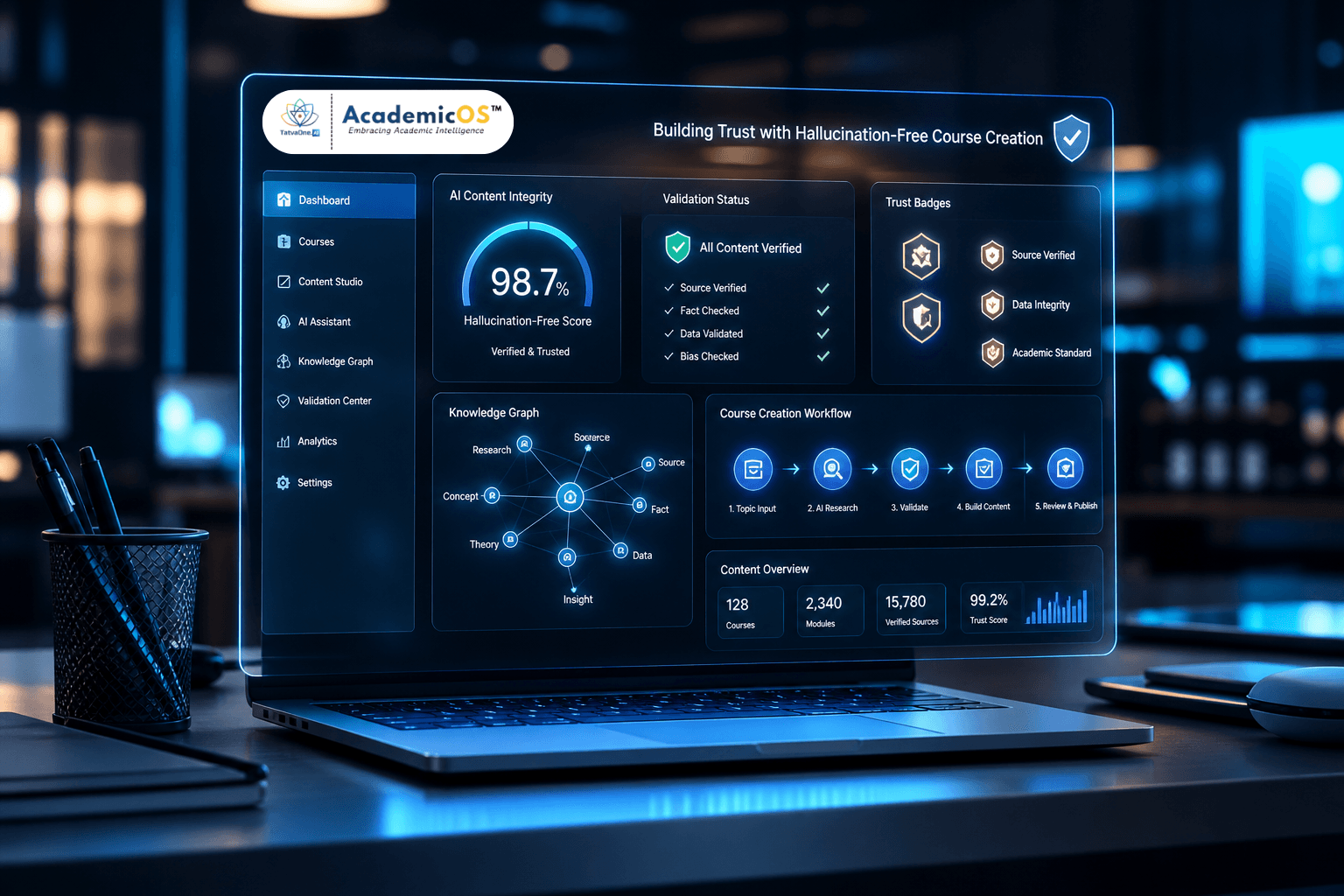
Discover what Content as a Service means and how AcademicOS.co helps L&D teams scale learning content creation faster and smarter.

The L&D Capacity Problem No One Talks About
Introduction
Most universities, EdTech companies, and enterprise L&D functions do not struggle because they lack ideas or curriculum. They struggle because they lack the operational automation capacity to turn those ideas into structured, high-quality learning content at scale.
New programs need to launch. Existing courses need annual updates. Assessments need to be aligned to outcomes. Accreditation evidence needs to be prepared and traceable. And all of this still depends on faculty time, SME availability, and manual content creation cycles that were never designed to scale.
This is where Content as a Service (CaaS) becomes not just useful — but essential. Not as a trend. Not as outsourcing. As a practical operating model for learning teams that need to produce more, faster, without compromising on quality or compliance.

What Is Content as a Service?
CaaS Explained
Content as a Service — commonly abbreviated as CaaS — is a delivery model where an organization shares its curriculum, standards, training requirements, and reference materials, and receives structured, ready-to-use learning content in return.
In academic and enterprise L&D contexts, CaaS outputs typically include:
- Course material — structured modules, units, and topic content aligned to outcomes
- Assessments — question banks, formative and summative evaluations, outcome-mapped instrument
- Teaching assets — presentation decks, facilitator guides, case studies, worked examples
- LMS-ready formats — SCORM packages, structured uploads, content hierarchy configured for delivery
- Accreditation documentation — coverage matrices, compliance reports, CO-PO attainment data
In simple terms: CaaS is an externalized content production engine — but one that is governed, structured, and aligned to institutional standards rather than generic output.
Why Traditional Content Production Breaks at Scale
The Problem
Most L&D teams and academic institutions try to solve content bottlenecks in one of three ways. Each fails in a predictable way.
| Approach | What Happens | Hidden Cost |
| Hiring internal teams | High cost + slow to scale | Months before output |
| Authoring tools (Articulate, Captivate) | Manual effort per course | Per-author licensing bleeds budget |
| Generic AI tools (ChatGPT, NotebookLM) | Fast but ungrounded | No curriculum alignment or audit trail |
| AcademicOS CaaS | Structured, scalable, SME reviewed, aligned | Institutionally governed & accreditation-ready |
The result of all three approaches is the same: content creation becomes the bottleneck instead of the enabler. Programs launch late. Assessment quality varies. Accreditation cycles create operational panic. Faculty burn out building slides for the fifth consecutive semester.
The solution is not faster content creation. It is smarter content architecture — which is exactly what an academic-grade CaaS model delivers.
How AcademicOS Reframes Content: From Output to Operating System
Platform Positioning
AcademicOS does not treat content as a standalone deliverable. It treats content as part of a broader academic operating system — one that connects curriculum, outcomes, delivery, assessment and dissemination into a single structured workflow.
Inside the AcademicOS platform, content is:
- Structured from curriculum — not created in isolation from what the program is trying to achieve
- Aligned to outcomes — every topic mapped to program and course outcomes, Bloom’s taxonomy levels, and delivery standards
- Traceable for accreditation — every piece of content carries an audit trail from curriculum input to delivery
- Usable across learning workflows — LMS delivery, classroom support, assessment, and student AI assistance all draw from the same structured layer
This is why AcademicOS is more than a content as a service learning platform. It is the CaaS layer of a larger curriculum intelligence platform and institutional learning platform built specifically for academic operations.
➜ See how this works end-to-end: AcademicOS Studio — Curriculum Intelligence Engine
How AcademicOS Powers CaaS at Scale: The 5-Step Process
How It Works
AcademicOS supports a repeatable, governed content delivery model that reduces manual authoring effort while keeping institutional academic control in place. Here is how the process works.
| 01 | You Bring the Academic Context Institutions provide curriculum outlines, learning outcomes, reference materials, and accreditation frameworks (AICTE, UGC NEP, NAAC, NBA, ABET). The process starts with institutional knowledge — not a blank template or a generic AI prompt. ✓ Eliminates context loss that generic tools suffer from. |
| 02 | The System Structures the Knowledge AcademicOS breaks the curriculum into a hierarchy — Program → Course → Chapters→ Unit → Topic — and maps each node to outcomes, Bloom’s taxonomy levels, and delivery formats. Structure comes before content — not as an afterthought. ✓ Fixes the most common failure point in eLearning content development. |
| 03 | AI-Assisted Content Development with SME Review Using AI-powered course creation workflows grounded in provided reference materials and textbooks, AcademicOS generates structured content scaffolding: topic introductions, concept outlines, teaching notes, examples, and case studies. Faculty review and refine in AcademicOS dynamic editor— not build from scratch. ✓ Reduces content creation workload by up to 80% while keeping academic quality intact. |
| 04 | Assessment is Built Into the Process Unlike traditional models where assessments are added at the end, AcademicOS builds question banks alongside content — Assessment Blueprint Builder supports Bloom’s taxonomy alignment, difficulty tagging, and outcome mapping built in from the start. This is the AcademicOS ecosystem in action. ✓ Makes outsourced course development actually assessment-ready. |
| 05 | Delivery in Formats That Work Outputs are delivered in LMS-ready structures, SCORM packages, structured documents, teaching aids, and PDF-to-eLearning course conversions. Content is usable immediately — no reformatting, no manual re-entry. ✓ True end-to-end content as a service delivery. |
From Textbooks and Manuals to Complete Learning Ecosystems
Use Case
One of the most powerful — and underutilized — use cases for AcademicOS CaaS is content transformation. Institutions and L&D teams are sitting on enormous repositories of existing material that cannot be used in modern learning environments in its current form:
| Source Material You Have | What AcademicOS CaaS Produces |
| Academic textbooks | Structured eLearning courses with outcomes, assessments, and delivery formats |
| Technical manuals | Training programs with scenario-based modules, knowledge checks, and role-based paths |
| PDF curriculum documents | LMS-ready course content with Bloom’s-mapped assessments and CO-PO matrices |
| Faculty lecture notes | Standardized course materials with structured teaching frameworks and reference alignment |
| Research papers & case studies | Case study-based learning modules with discussion frameworks and assessment instruments |
| Induction / onboarding materials | Structured onboarding programs with milestones, assessments, and compliance checks |
This capability moves Academicos beyond a basic AI course builder into a complete eLearning content development system — one that handles the full cycle from source material to delivery-ready learning.

Why Universities and Enterprise L&D Teams Adopt CaaS
Business Case
For both academic institutions and corporate L&D functions, the business case for Content as a Service is measured in four outcomes:
| Speed Courses that took months of manual authoring are structured in weeks — or less — with AI-assisted CaaS workflows. | Consistency Every course follows the same institutional framework. No more quality variation by department or individual faculty preference. | Scalability Content production is decoupled from headcount. Whether you launch 5 courses or 50, the system scales without proportional cost increases. | Alignment Content, assessments, and outcomes remain connected from day one. Nothing is bolted on as an afterthought. |
These outcomes are especially critical for teams looking for faculty workflow automation software that can reduce manual coordination, or an enterprise learning OS that scales content production without scaling headcount.
➜ See how outcome alignment is handled: Assessment Intelligence — AcademicOS
Where CaaS Fits in the AcademicOS Ecosystem
Platform Ecosystem
Content as a Service is not a standalone product within AcademicOS. It works because it is powered by a deeper academic operating system — one that connects every layer of the institution’s learning operations:
| AcademicOS Layer | What It Does for CaaS |
| Curriculum Intelligence Platform | Converts curriculum inputs into a structured content architecture before authoring begins |
| Institutional Learning Platform | Ensures content is delivery-ready across LMS, classroom, and hybrid formats from day one |
| Academic Automation Platform | Automates the workflow between curriculum → content → assessment → delivery → audit |
| Accreditation Readiness Software | Maintains compliance documentation continuously — not just at audit time |
| AI Assessment Ecosystem | Builds Bloom’s-mapped question banks in parallel with content — not after the fact |
| AskOS — Campus AI Assistant | Extends CaaS outputs into student-facing learning support and contextual academic guidance |
Together, these capabilities turn content creation from a one-off production task into a governed, repeatable institutional process.
➜ Accreditation documentation: Accreditation Readiness — AcademicOS

The Shift From Content Creation to Content Systems
Key Insight
The biggest mindset shift that CaaS enables is this: content is not the end product. It is part of an academic system.
When content is:
- structured from curriculum, not assembled from slides and notes
- aligned to outcomes, not tagged after the fact
- connected to assessments, not built in isolation from evaluation
- traceable for audits, not reconstructed from emails and spreadsheets
…it becomes more than content. It becomes an institution-wide learning system. That is what AcademicOS enables.
FAQs: Content as a Service, CaaS, and AcademicOS
-
Q: What is Content as a Service (CaaS)?
A: Content as a Service is a delivery model where an organization provides its curriculum, training requirements, and learning standards, and receives structured, ready-to-use learning content in return. Unlike generic content production, academic-grade CaaS includes outcome alignment, accreditation traceability, and assessment integration built into the output.
-
Q: How is AcademicOS different from a traditional content development agency?A: Traditional content agencies produce content manually based on briefs. AcademicOS is powered by an academic operating system — meaning it starts from your curriculum architecture, not a brief. Output is structured, outcome-mapped, Bloom’s taxonomy-aligned, and accreditation-ready. It is a system, not a service.
-
Q: Can AcademicOS support AI-powered course creation for large institutions?A: Yes. AcademicOS supports AI-assisted course creation grounded in your institution’s reference materials, curriculum frameworks, and regulatory requirements. It scales to multi-department, multi-program institutions without requiring proportional increases in faculty authoring effort.
-
Q: Does CaaS through AcademicOS support accreditation readiness?A: Yes. Every piece of content generated through AcademicOS carries a traceable audit trail. The platform maintains curriculum coverage reports, CO-PO attainment data, and framework-specific documentation (NAAC, NBA, ABET, AICTE, QAA) automatically — meaning accreditation readiness is a continuous state, not a pre-audit scramble.
-
Q: Is Content as a Service only for universities?
A: No. AcademicOS CaaS also works for enterprise L&D teams, EdTech companies, professional training organizations, and government skilling programs. Any team that needs to produce structured, outcome-aligned learning content at scale — and maintain compliance records — benefits from the model.
-
Q: What is the difference between an AI course builder and a curriculum intelligence platform?
A: An AI course builder generates content from prompts. A curriculum intelligence platform like AcademicOS starts from your curriculum standards and regulatory frameworks, structures the knowledge architecture, generates content within that structure, maps outcomes and assessments, and maintains the compliance trail — all in one governed workflow.
-
Q: Can AcademicOS convert existing textbooks or PDFs into eLearning courses?
A: Yes. AcademicOS supports transformation of existing source material — textbooks, PDFs, technical manuals, lecture notes, and case studies — into structured, LMS-ready eLearning content with outcome alignment and assessment integration built in.
-
Q: Does AcademicOS support engineering and mathematical content writing?
A: Yes. AcademicOS includes an advanced LaTeX-enabled editor designed for engineering, science, mathematics, and technical disciplines. It supports equations, formulas, derivations, symbols, tables, diagrams, and structured academic explanations, enabling institutions to create precise, publication-quality learning content for complex subjects.
-
Q: How does AcademicOS support images and visual assets for eLearning content?
A: AcademicOS provides access to a large library of human-curated, human-clicked images that can be used alongside course content, while also supporting text-to-prompt GenAI image generation for custom visuals. This helps institutions enrich lessons with relevant diagrams, illustrations, concept visuals, and media assets aligned to the topic and learning outcomes
About the Author

CEO | Education & Tech Platforms | Institution Builder | AI for Learning & Governance | Driving Scalable Education Solutions